Showing posts with label Blepharoplasty. Show all posts

Wednesday, February 8, 2012

Male Blepharoplasty Surgery


There are an increasing number of male patients who present to our office who are excellent candiates for upper blepharoplasty surgery. Typically male patients begin to notice that they have developed an obstruction of their visual fields. This often is described as having difficulty seeing when driving out of their peripheral vision, a feeling of heaviness, or feeling tired early at work or in front of the keyboard.


When blepharoplasty surgery is performed for male patients, there are subtle differences in terms of the amount and pattern of skin to be excised as well as the positioning of the eyelid crease. Satisfaction is quite high with male patients who undergo blepharoplasty surgery.


www.drbriandickinson.com

Blepharoplasty Surgery, Upper Eyelid Surgery


Blepharoplasty is a common procedure among young women. Women typically come into the office in consultation with a complaint that their eyes feel tired or heavy at the end of the day. They often describe a sensation of fullness on the lateral aspect of their upper eyelids that either makes them feel tired or look tired. 

Q: What is commonly involved in a blepharoplasty procedure?

A: Upper blepharoplasty procedures are very common. Blepharoplasty procedures are commonly performed under general anesthesia. I find that patients are often most comfortable under general anesthesia when performing surgery on the eyelids. I find that when the patient is relaxed, the entire surgical experience is much more enjoyable.

Q: What is the recovery time for upper blepharoplasty?

A: I typically tell patients that if surgery is done on Friday, on Monday they are fine going back to work...meaning e-mails, cell phone, phone conference meetings, or paperwork. Typically, I prefer if patients wait for a full two weeks before performing any heavy lifting or straining.

Patients are instructed to sleep with the head of their bed elevated for 48 hours to reduce swelling. Bruising can occur and can be visible for anywhere from 3 days to 3 weeks.

There is usually one suture placed on each eyelid that is removed at approximately 5 days following surgery.

All patients are given pain pills such as Percocet or Vicodin. Typically, patients do not complain of any pain following upper eyelid surgery and can easily convert to Tylenol or Motrin within a day or two.

www.drbriandickinson.com

Friday, November 18, 2011

Ptosis Repair & Eyelid Surgery


Eyelid ptosis occurs when the levator muscle of the eyelid can no longer lift the eyelid or maintain it in its proper position. This commonly occurs with aging and often also occurs concomitantly with the accumulation of excess skin along the upper eyelids. The accumulation of excess skin along the upper eyelids is called dermatochalasis. It is not uncommon for the excess skin to accumulate along the upper eyelids and eventually obstruct the visual fields. Removal of the excess skin of the upper lids is called and upper blepharoplasty surgery. Often ptosis repair and upper blepharoplasty surgery can be done at the same time.

Not only can these two surgeries restore a youthful appearance to the face, they can also improve the patient's visual field. These improvements can have a significant positive impact on a person's quality of life as they now look and feel well rested.

www.drbriandickinson.com

Thursday, May 5, 2011

Blepharoplasty in Facial Rejuvenation


Blepharoplasty is one of the more effective aesthetic procedures for facial rejuvenation in the right surgical candidate. Patients who present for upper blepharoplasty often complain of excessive skin or fullness in the upper outer quadrant of their eyes. Occasionally, this excess skin can obstruct their visual field or can simply cause a heavy feeling in the eyes giving the patient a tired appearance or tired outlook. Typically patients who undergo upper blepharoplasty report not only do they begin to look younger, but also feel younger.

http://www.drbriandickinson.com/

Tuesday, June 8, 2010

Facelift Surgery. Deep Plane Facelift


The deep plane facelift is a technique that can be used in conjunction with an upper and lower blepharoplasty as well as a coronal brow lift.While the deep plane facelift affords excellent correction of the nasolabial folds, jowls, and neck, I have found that the aperture of the upper eyelids can yield a significant positive impact on the aesthetic result on the overall youthful appearance of the face.

It is very common for women as they age to have an accumulation of skin on their upper eyelids. This accumulation of skin has been given the medical term, dermatochalasis. Often this accumulation can be asymmetric-meaning greater on one side versus the other and can create differences in the aperture of the eye.

It is important when correcting this asymmetry to note the location of the tarsal fold or eyelid crease.As you can see in the above photograph the patient's right eye has significantly more skin pre-operatively than the left eye. Careful notation of these asymmetries is important so that post-operatively the eyes can have equal apertures and yield an optimal aesthetic result.

www.drbriandickinson.com

Thursday, May 20, 2010

Facelift Surgery


While I enjoy all aspects of Plastic & Reconstructive surgery, facelift surgery is particularly enjoyable to me. Rejuvenation of the upper and lower eyelids is paramount to restoring a youthful appearance to the face.

As the face ages, the brow descends and skin accumulates around the upper lid and fat begins to herniate through the lower lid creating a tired appearance to the eye. While I do not encourage procedures during consultations, I often point out to patients who present for facelifts that small, subtle changes to the eye can yield a large difference. In this photograph one notices how effectively an upper blepharoplasty, or upper eyelid, procedure in conjunction with removal of fat from the lower eye can restore a youthful appearance to the face when utilized in conjunction with a facelift.

Facelift & Necklift Surgery


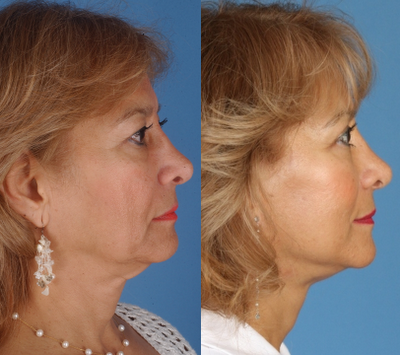
Facelift surgery can be particlarly rewarding for both the patient and physician. Frequently, I notice a youthful change in the appearance of the eyes without a single procedure being done to either the upper or lower eyelid.
I attribute this change to the repositioning of the cheek fat pad or malar fat pad back to the normal anatomical or pre-aged position. This restoration of volume not only recreates harmony to the lower eyelid and tear trough, but also improves the position and contour of the upper eyelid and seems to affect the overall aperture.

Facelift Surgery


Facelift surgery can be extremely rewarding for both the patient and surgeon. Typically patients who present for facelift surgery can range from 40 to 60 years of age. These patients almost invariably complain that despite having a good night of sleep, they continue to appear tired and then feel tired.

Blepharoplasty or eyelid surgery can enhance the surgical results of facelift surgery and significantly improve the surgical outcome. Quite commonly after facelift surgery, patients state that they have more energy, feel better rested, complain less, have fewer aches and pains, and are very happy with their decision to undergo facelift surgery.